
GUGI off Svalbard, and how much of the September story actually stands up
Reuters put out the McFarlane–Slattery exclusive on 10 September. It was datelined London and Washington and picked up, more or less verbatim, by Defense News, MarineLink, the Japan Times and the rest of the wire. Most of what it described had already been said out loud in April, by John Healey in London and Tore Sandvik in Oslo. The new material sat in three places. The rehearsal, according to two unnamed Western officials, had been off Svalbard. The Americans had been in on the interdiction. And GUGI had been practising with a piece of kit meant to kill a cable without leaving the usual mess.
Nobody cut anything. That needs saying early, because the write-ups have a habit of sliding into the language of plots and foiled attacks. The boats were turned back. London and Oslo then went to Moscow with what they had, which is a different sort of act from a press conference and rather more interesting.
GUGI is the Main Directorate of Deep-Sea Research, reporting to the defence ministry rather than through the ordinary naval chain. In the spring it put deep submersibles into the water north of Norway and, if the two officials are right, ran through the drill for laying that kit on the seabed. A British–Norwegian–American watch kept hold of them and eventually saw them off. Healey had already told the April cameras about an Akula used as a decoy and two GUGI boats. He had not named Svalbard, had not mentioned a weapon, and had not put the United States in the picture.
The cables in question run from Longyearbyen down to Andøya and Harstad. Two of them, laid in 2004, 1,375 km and 1,339 km, dropping in the Greenland Sea to something like 2,700 metres. They keep a small town online. They also carry the dump from SvalSat, which has gone from about a hundred dishes on the plateau in 2021 to more than 150, sits at 78°N, and is the only commercial station that can work all fourteen polar orbits. NASA uses it. So do a lot of other people who do not advertise the fact. Lose both lines and you have more than a dark island.
They also sit across the Bear Gap, that 400-mile sluice between southern Svalbard and the mainland through which a Northern Fleet boat has to pass if it wants the Atlantic. Jan Mayen sits on the same road. None of this is new geography. It has simply become harder to treat as a background condition.
April on the record, September on background
Healey did the Downing Street turn on 9 April. A month’s work, he said, in home waters and in the High North. Three Russian submarines: the Akula making a nuisance of itself, two GUGI boats doing the actual job. He spoke to Putin as if the man were in the room. “We see you. We see your activity around our underwater infrastructure.” Any attempt to damage it would have serious consequences. No damage had been found. The boats had gone.
Forces News later ran the numbers he gave at the London Defence Conference. About 500 people on the task. More than 450 hours in the air. A warship covering several thousand nautical miles. HMS Mersey was photographed with Admiral Grigorovich and the Kilo-class Krasnodar. Poseidons did the long patrols. Healey’s political line was that Moscow had used the Middle East as weather.
Sandvik put Norway in the same operation — a frigate, a P-8A — and said the work showed Russia still building the capacity to map Western infrastructure at depth and, if it came to it, to wreck it. They had already told the Russians, he said, that any attempt would be seen and answered. By September he was shorter: the joint operation had made it plain that covert work in those waters was no longer covert.
The London embassy called Healey’s version neither credible nor verifiable, denied any design on British cables, and shoved Nord Stream back onto the West. TASS ran it on the 9th and the 10th. That is still the last proper Russian reply. In September the defence ministry said nothing. The Kremlin said nothing. NATO sent Reuters back to London and Oslo. The White House did not pick up. The CIA had no comment.
Reuters did not hide the join. Britain and Norway had disclosed a covert operation in Arctic waters in April; the weapon, the location and the American part had not been reported. The same piece carried a second, looser claim from three U.S. officials: some analysts in Washington now think Moscow may try NATO’s Article 5, and that cables would be a handy thing to break if it did. Ratcliffe went to Moscow late in August, unannounced, partly to tell the Russians to stop winding up sabotage in Europe. Reuters could not find out whether he mentioned the seabed file. CBS, CNN and the Journal treated the trip as a warning not to test the Alliance, the Balts especially. Peskov allowed that there had been contact “through the intelligence services” and that Ratcliffe had not seen Putin.
Two old cables and a third that is not here yet
Space Norway owns the existing pair. They leave shallow water off Spitsbergen and then the bottom falls away. KSAT, which runs SvalSat, is not shy about the site: all-orbit support, uniquely placed, and now thick with antennas. The scientific traffic is real. So is the other traffic.
On 7 January 2022 one cable went dead. The break was 130 to 230 km out of Longyearbyen, right where the shelf drops from 300 metres to 2,700. The police called it “external influences” and thought it probably unintentional. A trawl remains the cleanest guess. It happened a few weeks before the invasion and has been tidied, in some briefings, into the Russian pattern. Nobody proved that. Undersea faults are beastly to prosecute and the 2022 case is a warning against doing the prosecutors’ work for them.
The two lines are near the end of a 25-year life. In February 2025 Space Norway signed SubCom for Arctic Way — 2,350 km, trunk and branch, Bodø to Jan Mayen to Longyearbyen, in service 2028 if the calendar holds, 2.8 billion kroner in the government frame. The cable is being made in Newington, New Hampshire. Rune Jensen has said the old pair will be kept as spare for some years after 2028. Until the new system is lit, the archipelago and a slice of polar downlink are hanging off two ageing fibres and the hope that January 2022 was a one-off.
The official who talked to Reuters about the Bear Gap was not being original. Every Northern Fleet planner knows the gap. In late August London put people on Jan Mayen anyway. Atlantic City ran from the 26th to 4 September under the Arctic Sentry banner: Royal Marines, RAF LXX, the Norwegian navy and Home Guard, U.S. Marines, sensors tied into what the Ministry called a kill web. Streeting, who had the defence job by then, called it a signal. Coming a few months after the spring turn-back and a fortnight before the Reuters piece, it was not a random date on the diary.
The directorate and its boats
Vice-Admiral Vladimir Vladimirovich Grishechkin is named by Forces News as GUGI’s head. The outfit grew out of late-Soviet work on nuclear deep stations. Accounts of the lean years have it holding on to funding through the 1990s, when much of the fleet was being broken up — a consistent characterisation in the open literature, not a line-item one can audit. Both Washington and London have sanctioned the directorate.
Olenya Guba is the base, on the Kola, perhaps a hundred kilometres from the Norwegian line. The deep boats sit under covered docks. Yantar ties up there. The Barents Observer wrote the place up years before most London papers had heard of it.
Losharik — AS-31, Project 10831 — is the one people reach for first. Titanium, built as linked spheres, meant for depths an ordinary attack boat cannot use. Published guesses wander from 2,000 or 2,500 metres up to figures nearer 6,000, which tells you how little is actually known. The battery fire on 1 July 2019 killed fourteen of the hydronauts. Trials after the rebuild were talked about in 2025. By last April her return was still listed as unconfirmed, and nobody in the open literature has nailed that down since.
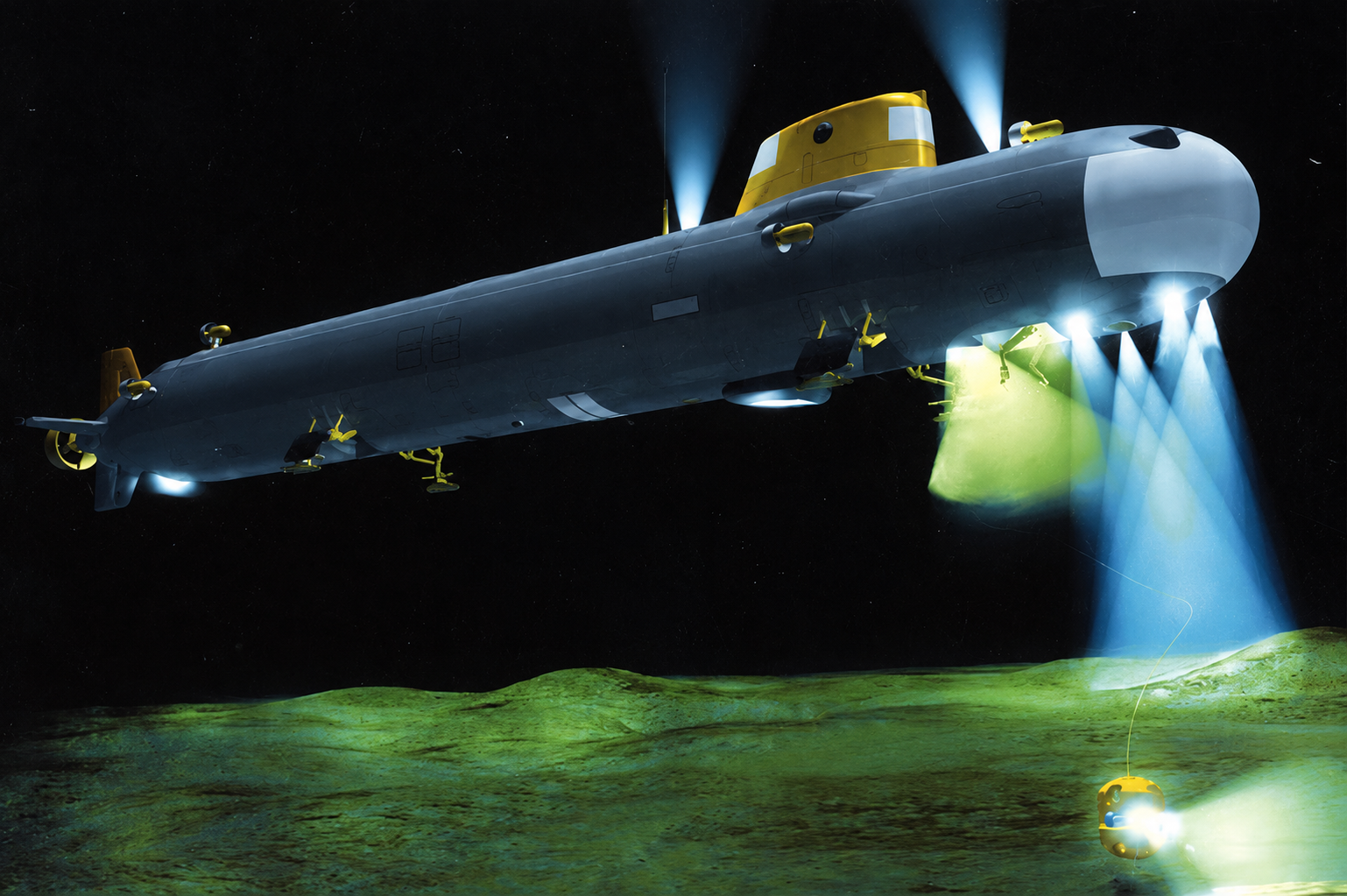
Belgorod, K-329, came out in July 2022: a stretched Oscar-II, 184 metres, 30,000 tonnes under, longest submarine in the water. She mothers the small special-purpose craft and can take Poseidon. Yantar is the ship the photographers catch near cables. Manned pots said to be good for 5,000 metres, ROVs, and the usual Russian television about plugging into other people’s lines. Podmoskovye and Evgeny Gorigledzhan sit in the same stable.
Sutton, after the April outing, called GUGI elite and noted that an Akula on tap is not a small courtesy. He also made the dull, important point: a fault at several thousand metres is a different repair from the shallow breaks cable ships fix every season.
As for the weapon itself, Reuters’ officials would not say how it worked. Sutton has not published a reconstruction. RUSI has not. “No fingerprints” is a phrase that does a lot of work — not an anchor, not an obvious charge, something done deep enough that looking is slow and dear. One can guess at a cut or a tap. Guessing is all it is. The Chinese Ship Scientific Research Centre showed a compact cutter in March 2025, rated to 4,000 metres, diamond wheel at 1,600 rpm, which at least proves other people are spending money on the same problem. TeleGeography’s line at the time was that grapnels already go that deep and the gadget looks more novel than it is. Different programme, different navy. It belongs in a footnote, not in the Svalbard file.
Other people’s cables, and Leipzig in passing
Western governments now talk about a campaign. Some of the file supports that. Some of it does not.
Nord Stream went up on 26 September 2022, three of the four strings, explosions off Bornholm. German prosecutors have spent the last year on Ukrainians. Serhii Kuznietsov, former officer, picked up in Italy in August 2025, sent over in November, indicted on 30 June this year as an accomplice. A diver, Vladimir Z., was arrested in Croatia on 19 August. Kyiv says the state had nothing to do with it. Moscow waves the case at anyone who says Russia blows up pipelines. The tidy version of Nord Stream has not survived contact with the indictment list.
Windward’s Baltic tally was at least eleven cables damaged or cut from October 2023 through the end of 2024. Balticconnector and the Estonia–Finland data links that October were tied to Newnew Polar Bear and Yi Peng 3 and to anchors. Eagle S, a shadow-fleet tanker in the Western phrase, was suspected of taking Estlink 2 and four data cables on Christmas Day 2024. The Finns boarded Fitburg on 31 December 2025. Surveying the high seas is legal. What the tracking firms sell is the pattern of boats that dawdle over the infrastructure. Reuters used Windward’s numbers: North Sea drifting up 52 per cent to 13,079 vessels; South China Sea up 88 per cent to 18,401; the Baltic a little down. Baltic Sentry started in January 2025. Nordic Warden, under the Joint Expeditionary Force, the same month. Atlantic Bastion is the British £1.5 billion attempt to keep a better eye on Russian boats in the approaches.
PST’s February assessment, delivered by Beate Gangås, said Russian intelligence would work the north harder in 2026, Svalbard and the northern counties especially, and would use civilian hulls and flags of convenience. Read now, it looks less like a generic warning and more like a notice posted before the spring serial. The Article 5 talk Reuters hung on three U.S. officials belongs in the same drawer: anticipation, not a description of something already done. Breaking a cable is not the armed attack the treaty was drafted around. It might be a way of finding out how far allies will stretch the text, and how long the lights stay off while they argue. Officials have started to say this. They have not shown it.
Leipzig is in here only because the week will not leave it out. Night of 4–5 August, a drone with explosives inside the fence at Leipzig/Halle, near a Ukrainian Antonov. A robot pulled the detonator. More devices later; one, in the subsequent reporting, with 50 grams of RDX. Dobrindt blamed Russia on 1 September — police work, pattern, intelligence. A U.S. official in Europe had already told CNN the assessment ran to a Russian service. The ambassador was summoned, the Bonn consulate-general scheduled for closure, the lease on the Russian House in Berlin pulled. Putin called it a serious mistake and talked about fabricated evidence. Kallas reached for “state-sponsored terrorism.” None of that proves anything about Svalbard. It does show how full the tray has become.
Telling Moscow, and what Moscow does with that
The part of the Western response that is easy to miss is the private message. Reuters says British and Norwegian officials took the finding to Moscow and let the Russians know the kit had been seen. Healey’s April press conference then said a version of the same thing with the interesting nouns left out. Ratcliffe’s August call was another note of the same sort, sent through the services rather than the podium. Whether anyone in the Kremlin adjusted a plan is not a question the open record can answer.
Moscow’s habit, at least in public, is tidy enough. Fresh claims sit unanswered. Old ones are called unverifiable. The loudest seabed attack of the decade is hung on Ukrainians and, by implication, on whoever arms them. Fog is not an accident in this work. A rehearsal stopped short can be oceanography if anyone asks. A cable that dies at 2,000 metres can be a trawl or a manufacturing fault or a cut, and by the time a ship has filmed the seabed the political week has moved on.
Jones at Brookings got the European bind into one remark that Reuters printed and everyone has since borrowed. Twenty-five years of laying more on the seabed while the forces that might look after it were cut. Rebuilding now, late, against a Russian problem that has stopped being hypothetical. Daniel at Windward, from the commercial side, put Russia and China at the top of the list his clients pay him to watch.
Weight, gaps, and what to look at next
The last pages are assessment, not a third Reuters story. The sourcing does not improve as the piece goes on; the licence to judge does, and that ought to be visible.
Keep the three September novelties on a tight lead. Weapon, Svalbard, American ships: two officials, no name, not repeated by the ministries that would have to live with the words. They can still be right. They are not yet in the same box as Healey and Sandvik in April. The upgrade comes when London, Oslo or an American with a job title says the place and describes the gear.
There was no cut. Calling it a foiled attack makes copy. On the available account it was a serial that did not finish, which is not the same as harmless. One inference — and it is an inference — is that a service does not run a quiet-cut drill at that depth as a technical amusement. It runs it because it wants the option on the shelf. The further leap, to war this winter, is the leap a certain kind of briefing likes. The plainer reading is that Moscow is stocking a tool and checking whether anyone is awake.
The rest of the file is crooked in ways that belong in the text rather than in a footnote. Nord Stream is a German case against Ukrainians as well as a Russian talking point. The 2022 Svalbard fault was written down as probably accidental. Losharik may or may not be back; the open sources will not say. Lengths and depths slip around because the interesting boats are classified and the cables were laid by contractors who saw no reason to publish every sounding. Drop those hedges and the piece stops being a reading of the record.
A few things are worth watching without turning them into a numbered list. A minister who names Svalbard or describes the mechanism. A photograph, a RUSI note, a sanctions line that points at a system rather than at GUGI as a blob. Whether the next European package, the 22nd, takes any of the directorate’s people. Arctic Way’s date: 2028 sliding into 2029 leaves the old pair as a single point of failure for another season. And the next time a GUGI hull is painted in the gap — whether the answer is another quiet shepherding or something done in front of cameras.
For a long time the seabed was treated as a commons that failed in the ordinary ways, trawls and age and bad luck. That assumption looks finished, even if the replacement is still being improvised: more patrol hours, cable ships kept closer to hand, lawyers working the shadow fleet, and the dull business of putting down more fibre than anyone can cut in an afternoon. If the September account is mostly right, GUGI spent part of the spring rehearsing for a fight that has not been declared. The least theatrical Western reply is also the one that would count: make the rehearsal look, afterwards, like a very dear way of finding out that the other side was looking.
/Staffan Scherloff
Principal sources
McFarlane, Sarah, and Gram Slattery. Reuters exclusive, 10 September 2026 (Defense News, U.S. News, Insurance Journal, MarineLink, Marine Technology News, AOL, The Japan Times).
Healey, John. Downing Street and London Defence Conference, 9 April 2026; Forces News and Ministry of Defence accounts.
Sandvik, Tore O. 9 April 2026, and remarks in the 10 September Reuters piece.
Embassy of the Russian Federation, London / TASS, 9–10 April 2026.
Space Norway press release, 14 February 2025, on Arctic Way; later notes on the Bodø–Jan Mayen–Longyearbyen route.
KSAT on SvalSat.
Norwegian police and contemporary reporting on the 7 January 2022 Svalbard fault.
Barents Observer on Olenya Guba.
H.I. Sutton, quoted by Forces News, April 2026.
Windward figures on Baltic cuts (October 2023–end 2024) and drifting, as cited by Reuters.
PST annual threat assessment, Beate Gangås, February 2026.
Ratcliffe’s late-August Moscow visit: CBS, CNN, Wall Street Journal; Peskov.
Leipzig/Halle, 4–5 August 2026, and Dobrindt’s attribution, 1 September 2026: CNN; NPR, 2 September; Kallas.
Bruce Jones and Ami Daniel, quoted by Reuters, 10 September 2026.
German process against Serhii K. (indicted 30 June 2026) and Vladimir Z. (arrested 19 August 2026).
Baltic Sentry, Nordic Warden, Atlantic Bastion, Operation Atlantic City (26 August–4 September 2026).